A touchscreen-first hi-fi media appliance built on Debian for x86 hardware. Bit-perfect audio, streaming services, and OTA updates — all in one sleek dark interface.
Flash one ISO image to a USB stick for the first install. From then on, every update — UI, system and OS — is delivered automatically over the air.
⚠️ Were you in the private beta? You need to reinstall from the latest ISO below — an over-the-air update will not get you there.
Osmium Flasher downloads the image itself, checks its signature and writes the stick for you, then walks you through booting the mini PC and running the installer on it. No other tool, and no chance of picking the wrong disk — your system drive is never even listed. Pick the computer you will prepare the stick on, not the mini PC.
There is no macOS build. macOS guards raw disk devices with a permission it grants by code signature, and an unsigned application cannot obtain it — the app could fetch and verify the image, but never write it.
Download the image below and write it with balenaEtcher instead. It is signed and notarized by its makers, so macOS lets it do what it needs to. Everything after that — booting the mini PC and running the installer — is exactly the same.
Heads up: the app is not code-signed, so Windows and macOS will warn you the first time you open it. That is expected, and the note below says how to get past it.
Osmium Flasher is not code-signed, so SmartScreen stops it the first time. Click More info, then Run anyway. Windows will also ask for administrator rights: writing to a raw device needs them.
Make it executable with chmod +x Osmium-Flasher-*.run and run it. No warning to dismiss; you will get a polkit password prompt when the write starts. It is a self-extracting executable rather than an AppImage on purpose — an AppImage is mounted so that root cannot read it, which is exactly what the elevated write needs to do.
Rather write the stick yourself? Download the image and use balenaEtcher, Rufus or dd.
hifi-player-v2.5.21.iso is now ready! Click the link to start your download.
Use Osmium Flasher above on an 8 GB+ stick — it fetches and verifies the image itself. Prefer to do it by hand? balenaEtcher, Rufus and dd all still work.
Turn Secure Boot off in the firmware setup first — it is required on every machine. Then boot your x86 mini-PC from the stick and follow the on-screen installer. Reboot — you're done.
Note: the installer asks which disk to install on before formatting it — nothing is wiped without confirmation (tested on UEFI; the ISO is only needed for the first install, every later version arrives automatically over the air).
Try it live: pick Try Osmium Sound (no install) at the boot menu to run the kiosk straight from the USB stick, nothing written to disk. If it doesn't log in automatically, use hifi / hifi at the login screen.
Step by step: writing the USB stick, first boot, device modes, web admin, music sources, DSP, multiroom, backup, OTA updates and troubleshooting — in English and Italian.
Open the manualBuilt for audiophiles who want a dedicated, appliance-grade media server without the complexity.
Native playback of FLAC, DSD, and PCM up to 192kHz. Bit-perfect DoP output over USB — no resampling, no compromise.
Deezer, Qobuz, TIDAL, Spotify and more — unified in one interface via Lyrion plugins, installed in one click from the web UI. No app switching.
Browse your local collection by Artist, Album, or Folder. Fast indexing powered by Lyrion Media Server.
Built-in radio browser with thousands of stations worldwide. Save favourites directly from the touchscreen interface.
Automatically detects USB DACs and audio interfaces. Switch outputs on the fly with persistent selection across reboots.
Signed over-the-air updates for UI, API daemon, and OS. Switch between Production and Development channels from settings.
Optimised for touchscreens. Clean, dark, distraction-free.
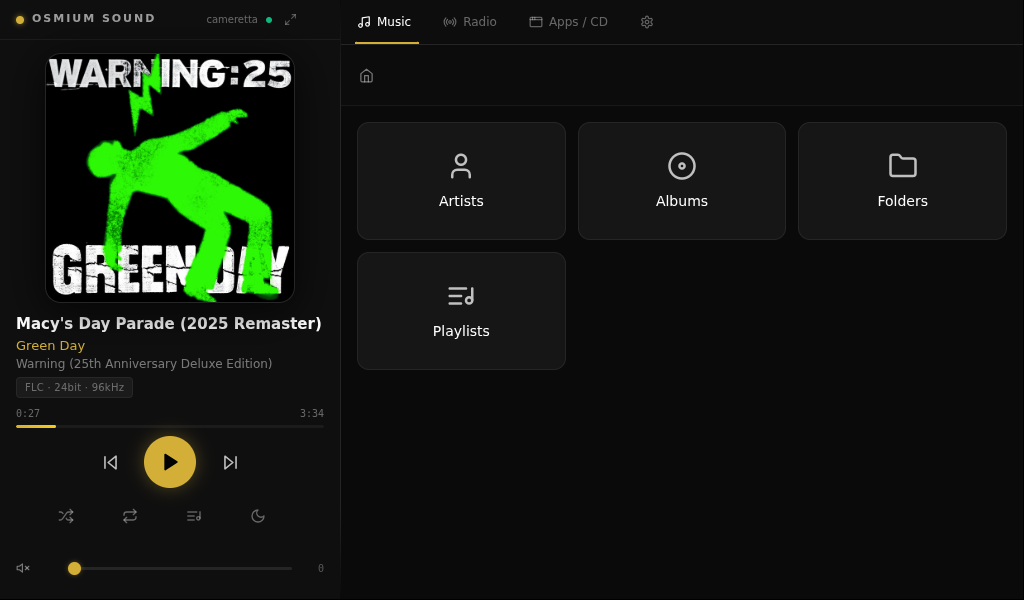
Images are indicative and may differ from the current version as the interface evolves.

| Hardware | x86 / x86-64 |
| OS | Custom Debian distro |
| Interface | Electron + React |
| Backend | Node.js API daemon |
| Media server | Lyrion Media Server |
| Update system | Signed OTA (Ed25519) |
| License | MIT |
| Formats | FLAC, DSD, MP3, AAC, WAV, AIFF |
| Max resolution | 32-bit / 192kHz PCM |
| DSD support | DSD64, DSD128, DSD256 (DoP) |
| Output | USB DAC, HDMI |
| Playback mode | Bit-perfect (no resampling) |
| VU meters | Analog-style real-time display |
| Streaming | Deezer, Qobuz, TIDAL, Spotify (via Lyrion plugins) |
Control Osmium Sound from your phone. Browse your library, drive playback and the queue, and adjust volume — pair in seconds by scanning the QR code on the device's Settings screen.
Grab HiFiMediaPlayer-companion-v1.0.6-release.apk using the button above.
Open the APK on your phone and allow install from unknown sources when prompted. Requires Android 8.0 or newer.
On the same Wi-Fi, open the app and scan the pairing QR code from the device's Settings → Phone control.
There is no Osmium companion app for Apple devices. We suggest LyrPlay, a third-party app by Eric Miller: it connects to the Lyrion Music Server running on your Osmium device, gives you the Material interface to drive playback, and can also turn the iPhone or iPad itself into another player on the network. It is free, with an optional paid icon pack. It is not our app, we have no connection with its author and we cannot support it — we are simply recommending something that works well with Osmium Sound.
LyrPlay on the App StoreScan it to open LyrPlay in the App Store on your phone.
Note: the companion app is distributed as a signed APK (sideload) or via our self-hosted F-Droid repo — it is not on the Play Store. Prefer F-Droid if you want automatic updates: tap Add F-Droid repo above (F-Droid app required), or add https://osmiumsound.it/fdroid/repo manually under Settings → Repositories. Your phone and the appliance must be on the same local network.
Write to support@osmiumsound.it and an issue is opened automatically on the project's GitHub repository, so it can be tracked and followed up like any other bug or request. Please describe your issue clearly (what happened, what you expected, and any relevant details like your ISO/APK version) — this becomes the issue text.
Email support@osmiumsound.itFile it yourself directly on the project's GitHub repository — the same place your email would end up anyway, just skipping the middle step.
Open an issue on GitHub