Live on YouTube: the Osmium Sound launch, in Italian on Friday 16 October and in English on Saturday 17 October. Sign up free →

OSMIUM SOUND

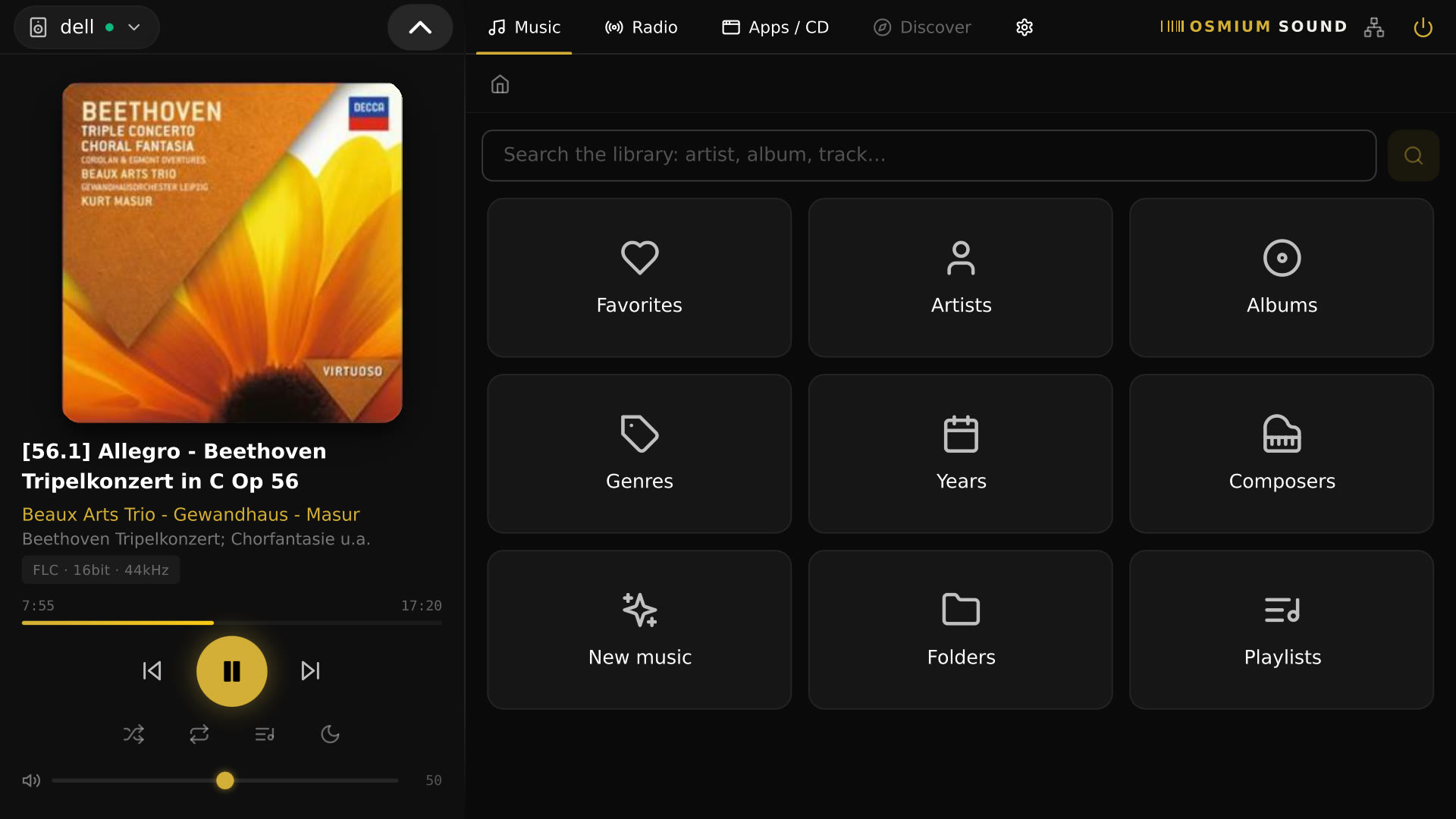
Hi-fi on the mini PC you already own. Osmium Sound turns an x86 mini PC into a touchscreen music player: bit-perfect playback, streaming services and CD ripping.

Get started View on GitHub Watch the demo Follow us on Facebook
Live on YouTube: 16 and 17 October New: older PCs with BIOS work too x86 · Debian FLAC · DSD · 192kHz Deezer · Qobuz · TIDAL · Spotify AGPL-3.0 Open Source Android app on Google Play

The Osmium Sound launch event

One hour live: we show Osmium Sound at work and answer your questions. It is free: sign up on Eventbrite and the YouTube link reaches you by email before it starts.

In Italian

Launch event — Italian edition

Friday 16 October 2026 9:00 to 10:00 PM, Italian time

In English

Discover Osmium Sound — Launch Event

Saturday 17 October 2026 6:00 to 7:00 PM, Italian time

Stuck, or just want to tell us how it is going? Write to us by email or on GitHub: every way to reach us. If you enjoy Osmium Sound you can also support the work with a voluntary donation, or follow the news on Facebook.

What you need

No high-end hardware needed: Osmium Sound runs well on inexpensive or recycled mini PCs. Details in the manual.

New: UEFI is no longer a requirement. From version 2.5.25 Osmium Sound installs and starts on PCs with UEFI and also on older PCs with a traditional BIOS, so even a PC from before 2015 can become your music player.

Components

Computerx86-64 (64-bit) mini PC, with UEFI or with a traditional BIOS: both work from version 2.5.25.
StorageInternal disk/SSD to install onto (16 GB recommended, 8 GB minimum)
USB stick8 GB or larger, needed only for the initial install
Screen (optional)Touchscreen recommended for “with screen” mode. Supported resolutions are the ones in Settings: Automatic, 1280×720, 1920×1080 or the screen’s native resolution. Not needed in headless or server-only mode.
Audio outputUSB DAC or HDMI output
NetworkEthernet or Wi-Fi
Setup deviceAny device with a browser — phone, tablet or PC — for installation and first setup

Processors found in most mini PCs

Intel Corei3/i5/i7/i9 from the 6th generation “Skylake” (2015) onwards, Core Ultra too
Intel Celeron / Pentium / Atom / N-series“Braswell” (2015), “Apollo Lake” (2016), “Gemini Lake” (2017–2019), “Jasper Lake” (2021), “Alder Lake-N” (N95/N100/N200/i3-N305, 2023), “Twin Lake” (N150, 2025) — the chips found in most mini PCs
AMDAny Ryzen (2017 onwards, every generation) or Athlon on the AM4 socket; A-series APUs “Carrizo” (2015) and “Bristol Ridge” (2016)
Older PCsFrom version 2.5.25 they work too, even without UEFI: the installer also starts in BIOS mode
AvoidAtom “Bay Trail”/“Cherry Trail” tablets and HDMI sticks (2013–2015): many have a 32-bit UEFI that cannot boot the 64-bit image

Download & install

Flash one ISO image to a USB stick for the first install. From then on, every new version arrives over the air: it is installed next to the current one while the device keeps playing, and if it does not start properly the device goes back to the previous one by itself.

Runs on standard x86 PCs, with UEFI or with a traditional BIOS: from version 2.5.25 older PCs without UEFI work too. Chromebooks are not supported. See the requirements.

The simplest way

Osmium Flasher does it all for you: it downloads Osmium Sound, checks that the file is intact, copies it to the USB stick, then shows you step by step how to start the mini PC and finish the installation. No other program needed, and no way to wipe the computer you are using by mistake.

Not your system? Pick the system of the computer you will prepare the stick on — not the mini PC: Windows · macOS · Linux

Rather write the stick yourself? Download the image and use balenaEtcher, Rufus or dd.

Download ISOv2.5.25 All releases
1

Download the ISO

hifi-player-v2.5.25.iso is now ready! Click the link to start your download.

2

Flash a USB stick

Use Osmium Flasher above on an 8 GB+ stick — it fetches and verifies the image itself. Prefer to do it by hand? balenaEtcher, Rufus and dd all still work.

3

Boot & install

Boot your x86 mini-PC from the stick and follow the on-screen installer. Reboot — you're done.

Common installation issues

Secure Boot — you can leave it on: the installer and the installed system are signed. If a machine still refuses to start from the stick, turn it off in the firmware setup.

Windows — “unknown publisher”. Osmium Flasher is not code-signed, so SmartScreen stops it the first time. Click More info, then Run anyway. Windows will also ask for administrator rights: they are needed to write to the USB stick.

Linux — password prompt. You will get a polkit password prompt when the write starts. It is a self-extracting executable rather than an AppImage on purpose — an AppImage is mounted so that root cannot read it, which is exactly what the elevated write needs to do.

Chromebooks — their firmware is locked down by the manufacturer and refuses to boot anything else, unless you flash third-party modified firmware (not provided or endorsed by the manufacturer) and/or use drivers dedicated to that specific platform — neither of which this project provides or supports.

Note: the installer asks which disk to install on before formatting it — nothing is wiped without confirmation (the ISO is only needed for the first install, every later version arrives automatically over the air).

Try it live: pick Try Osmium Sound (no install) at the boot menu to run the interface straight from the USB stick, nothing written to disk.

Verified on the platforms we tested: there, every feature has been checked and validated. The x86 hardware landscape is vast, though: we can't rule out issues on other hardware combinations. If you run into one, please report it through the official channels below — it really helps.

Coming back from the private beta?

Were you in the private beta on a Debian 12 build? You need to reinstall from the latest ISO above: starting with the next release, Debian 12 is no longer supported and will not receive over-the-air updates any more — so you will not be able to update from it.

📖

Full installation & configuration manual

Step by step: writing the USB stick, first boot, device modes, web admin, music sources, backup, OTA updates and troubleshooting — in English and Italian.

Open the manual

Everything your hi-fi setup needs

Built for audiophiles who want a dedicated, appliance-grade media server without the complexity.

🎵

High-Resolution Audio

Native playback of FLAC, DSD, and PCM up to 192kHz. Bit-perfect DoP output over USB — no resampling, no compromise.

FLACDSD64/128/256192kHzDoP
🎧

Streaming Services

Deezer, Qobuz, TIDAL, Spotify and more — unified in one interface via Lyrion plugins, installed in one click from the web UI. No app switching.

DeezerQobuzTIDALSpotify
📁

Music Library

Browse your local collection by Artist, Album, or Folder. Fast indexing powered by Lyrion Music Server.

ArtistsAlbumsFoldersLyrion
💾

Music Sources

USB drives, internal disks (adopt or format them from the interface) and NAS shares found for you on the network. Internal disks can be shared back on your network, and a file manager in the web admin copies, moves and renames your music.

USBInternal disksNAS / SMB
💿

CD Playback & Ripping

Insert a disc, play it or rip it to tagged FLAC — with MusicBrainz metadata and cover art — straight into your library.

FLACMusicBrainzCover art
🧭

Discover

Endless random mixes, “keep playing similar music”, similar artists and artist bios, right on the touchscreen.

Random mixesSimilar artistsBios
📻

Internet Radio

Built-in radio browser with thousands of stations worldwide. Save favourites directly from the touchscreen interface.

Radio BrowserFavourites
🎚️

Analog VU Meters

Six built-in looks, more downloadable from a signed online catalogue, plus a status plate showing Hi-Res/PCM/DSD and BitPerfect/ReplayGain.

6 looksOnline catalogueBitPerfect
🔀

Any Player, One Screen

Drive the other players on the same Lyrion from the touchscreen, then come back to this one. The device can also play from a Lyrion server already on your network.

LyrionOther players
🔌

DAC Auto-Detection

Automatically detects USB DACs and audio interfaces. Switch outputs on the fly with persistent selection across reboots.

USB DACHDMI
🖥️

With Screen or Without

Touchscreen player, headless (controlled from the web admin and the companion app), or server-only: it serves Lyrion to the other players and plays nothing itself.

ScreenHeadlessServer-only
🌐

Web Admin

Manage the device from any browser on your network: network, audio, music sources, updates, backups, SSH and Tailscale remote access.

Any browserUpdatesTailscale
📱

Android Companion App

Browse, control playback and the queue, adjust volume and reach the web admin's settings from your phone, or turn the device off. Pair by QR code. The phone can also be a player itself. Free on Google Play.

Google PlayQR pairingSettingsPhone as player
💼

Backup & Restore

Profile backups of settings, sources and Lyrion preferences — Wi-Fi and accounts too, encrypted, if you want — scheduled or on demand, and restorable even from the first-boot setup.

ScheduledEncryptedFirst boot
⬆️

Safe OTA Updates

Every new version arrives over the air, signed, and is installed next to the current one while music keeps playing. If it does not start properly, the device goes back to the previous one by itself. Production and Development channels.

SignedAutomatic rollbackProd channelDev channel

Designed for the listening room

Optimised for touchscreens. Clean, dark, distraction-free.

Watch it in action

Built on solid foundations

Platform

Hardwarex86-64 mini PC (Intel integrated graphics is plenty)
Display1024×600 touchscreen (optimised for this resolution); also runs without a screen
OSDebian 13 “trixie”: a read-only system image (~850 MiB) in two A/B slots, settings and music on a separate data partition
InterfaceNative Qt 6 / QML app drawing straight to the display over DRM/KMS (no X server, no compositor) — about 3.3 W and 175 MB on Now Playing with the VU meters, against 4.9 W and 650 MB for the previous Electron interface; a web admin for any browser on the LAN
BackendPython services
Media serverLyrion Music Server (on this device, or one already on your network), web player on Material Skin with the “Osmium” theme
Update systemWhole-system A/B updates with automatic rollback (RAUC, signed); Prod/Dev channels
LicenseAGPL-3.0 (application code); commercial licenses available

Audio

FormatsFLAC, DSD, MP3, AAC, WAV, AIFF
Max resolution32-bit / 192kHz PCM
DSD supportDSD64, DSD128, DSD256 (DoP)
OutputUSB DAC, HDMI
Playback modeBit-perfect (no resampling)
VU metersSix built-in looks, more downloadable from a signed online catalogue
StreamingDeezer, Qobuz, TIDAL, Spotify (via Lyrion plugins)

Android companion app

Control Osmium Sound from your phone. Browse your library, drive playback and the queue, and adjust volume — pair in seconds by scanning the QR code on the device's Settings screen.

Get it on Google Play Disponibile su Google Play

Reading this on a computer? Scan the code with your phone to open the app on Google Play.

Free on Google Play, with automatic updates. Requires Android 8.0 or newer.

1

Install from Google Play

Tap the badge above, scan the code, or search for Osmium Sound Companion in Google Play. If you would rather skip Google Play, the APK and F-Droid buttons give you the very same app.

2

Pair by QR

On the same Wi-Fi, open the app and scan the pairing QR code from the device's Settings → Phone control.

3

Sit back

Browse your library, drive playback and the queue, adjust the volume and reach the device's settings — all from the couch.

On iPhone and iPad

There is no Osmium companion app for Apple devices. We suggest LyrPlay, a third-party app by Eric Miller: it connects to the Lyrion Music Server running on your Osmium device, gives you the Material interface to drive playback, and can also turn the iPhone or iPad itself into another player on the network. It is free, with an optional paid icon pack. It is not our app, we have no connection with its author and we cannot support it — we are simply recommending something that works well with Osmium Sound.

LyrPlay on the App Store

Scan it to open LyrPlay in the App Store on your phone.

Note: the APK and our own F-Droid repository give you the very same app as Google Play, for phones without Google services or if you simply prefer it that way. For automatic updates outside Google Play use F-Droid: tap Add F-Droid repo above (F-Droid app required), or add https://osmiumsound.it/fdroid/repo manually under Settings → Repositories. Whichever way you install it, your phone and the device must be on the same local network.

✉️

Need help? Email support

Write to support@osmiumsound.it. Say what happened, what you expected, and the details that save a round of questions: the version and update channel, whether the device runs with a screen, headless or server-only, and the exact message you saw.

Email support@osmiumsound.it

Not a bug or a request to track? For general enquiries write to info@osmiumsound.it instead.

🐙

Prefer GitHub? Open an issue

File it yourself directly on the project's GitHub repository. The right place for something reproducible that you would rather discuss in the open, next to the code.

Open an issue on GitHub